
Vape Products
Wholesale to DTC for Vape Businesses: A Step-by-Step Roadmap
For an established vape wholesaler, adding direct-to-consumer sales can create a new path to revenue without requiring you to build an entirely new operation. Here's what you already have, what's genuinely new, and a practical roadmap for launching DTC.
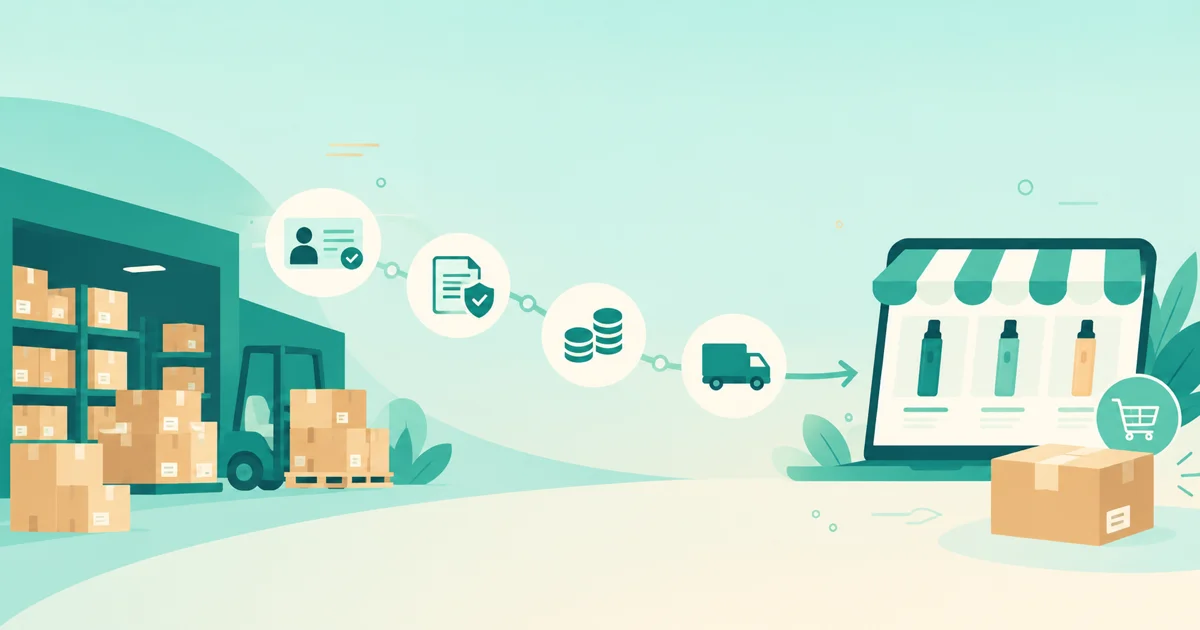
For an established vape wholesaler, adding direct-to-consumer sales can create a new path to revenue without requiring you to build an entirely new operation.
You may already have products, inventory, warehouse capacity, supplier relationships, state registrations, tax processes, and experience operating in a regulated industry.
That gives you a head start.
The challenge is that selling Electronic Nicotine Delivery Systems, or ENDS, directly to consumers creates requirements that may not be part of your wholesale workflow.
Depending on where and how you sell, your DTC operation may need additional registrations, licensing, age verification, tax processes, PACT Act reporting, shipping controls, ecommerce technology, and transaction records.
The simplest way to approach the transition is to separate what you already have from what you still need.
What You’ll Need to Address Before Launching DTC
A vape wholesaler moving into DTC should generally evaluate seven areas before launch:
- State and local registrations and licensing
- Product eligibility and sales restrictions
- PACT Act registration and reporting
- Online age and identity verification
- State and local excise tax requirements
- Shipping and delivery
- Ecommerce, fulfillment, and compliance recordkeeping
The exact requirements depend on the products sold, where the business operates, and where customers are located.
The roadmap below breaks these areas into practical steps.
Step 1: Inventory What Your Wholesale Business Already Has
Do not begin by creating a list of everything needed to run an ecommerce business.
Start with what you already have.
An established wholesaler may already have a significant portion of the operational foundation required for DTC.
| You may already have | What to evaluate for DTC |
|---|---|
| State registrations | Determine whether current registrations cover DTC activity |
| State or local licenses | Confirm whether additional retail or remote seller licensing applies |
| Warehouse | Determine whether it can support individual consumer fulfillment |
| Inventory | Confirm which products can be offered in each target market |
| Supplier relationships | Review whether agreements permit DTC sales |
| Tax processes | Determine what additional DTC and destination-based obligations apply |
| Compliance expertise | Add consumer-specific requirements to existing processes |
| Accounting or ERP systems | Determine whether transaction-level DTC data can be captured |
| Fulfillment processes | Adapt case or pallet workflows for individual orders |
| Existing website | Determine whether it can support ecommerce and verification |
The goal is to identify the gap between your existing wholesale operation and the DTC operation you want to launch.
That gap becomes the basis for your implementation plan, budget, and timeline.
Step 2: Decide Where You Want to Sell DTC
One of the most important decisions is also one of the earliest:
Where will you accept DTC orders?
For ENDS sellers, launching ecommerce should not automatically mean turning on sales in every state.
The PACT Act requires covered delivery sellers to comply with applicable state, local, and tribal requirements. Those requirements can include licensing, excise taxes, tax stamping, age restrictions, reporting, and other rules governing the sale and delivery of regulated products.
That makes geography part of your compliance architecture.
Instead of approaching DTC as a nationwide launch, consider creating a jurisdiction matrix.
For each state or locality you plan to serve, identify:
- Registration requirements
- Retail or remote seller licensing
- ENDS excise taxes
- Applicable sales restrictions
- Age requirements
- Reporting obligations
- Delivery requirements
- Product restrictions
A phased launch can make this process easier to manage.
Start with the jurisdictions your team has reviewed and can support operationally. Then expand as your DTC workflows mature.
Step 3: Confirm Your PACT Act Requirements
The PACT Act is a central consideration for businesses selling ENDS remotely.
ATF states that a person or business selling, transferring, or shipping ENDS for profit in interstate commerce must register with ATF when the statutory requirements apply. In practice, this means most ENDS sellers engaged in interstate commerce will need to register under the PACT Act as amended by the 2021 expansion, which extended the Act's registration and reporting requirements to ENDS products. Businesses may also need to register with states and localities into which taxable ENDS products are shipped.
Covered businesses can also have monthly reporting obligations.
ATF states that PACT Act reports are generally due to applicable tobacco tax administrators on the 10th day of each calendar month for shipments made during the previous month.
Those reports can require transaction details such as the customer's name and address, product brand and quantity, and information about the person delivering the shipment.
Your DTC system therefore needs to do more than process an order.
It needs to capture the information required to support your reporting and compliance workflows.
Step 4: Build Age Verification Into the Customer Journey
Moving from wholesale to DTC means you are now selling regulated products directly to individual consumers.
Federal law prohibits retailers from selling tobacco products, including e-cigarettes and other ENDS, to anyone younger than 21. Federal requirements also apply to identification checks, while state and local requirements can add additional obligations.
Because those state and local requirements can be stricter than the federal floor, your age verification solution should be configurable rather than fixed to a single national rule — able to adhere not only to the federal minimum age of 21 but also to more restrictive age or identification requirements in specific jurisdictions.
For an ecommerce merchant, age verification should therefore be treated as part of the transaction workflow rather than as a separate step added after the store is built.
A typical process might look like:
Customer → Cart → Age and identity check → Checkout → Payment → Fulfillment → Delivery
The specific implementation should match the requirements applicable to your business and the jurisdictions you serve.
The objective is to verify eligibility while keeping the purchasing process as straightforward as possible for eligible customers.
Step 5: Plan for Excise Tax and PACT Reporting
Wholesale businesses may already have tax registrations and processes.
DTC can add another layer.
PACT Act delivery sales can be subject to applicable state, local, and tribal laws, including excise taxes, licensing, tax stamping, restrictions on sales to minors, and other requirements.
Excise tax bases and rates vary by state, and a given state's tax can hinge on factors like nicotine content or e-liquid volume rather than a flat per-unit or percentage-of-price rate — which is part of why manually tracking excise tax across jurisdictions gets complicated quickly, and why many DTC sellers move to an automated, configurable tax engine instead.
Before launch, determine:
- Where you have an excise tax obligation
- How applicable taxes will be calculated
- When taxes need to be collected
- What information must appear in reports
- Which jurisdictions receive reports
- Who owns the monthly reporting process
- How transaction records will be stored and retrieved
Your ecommerce, tax, and reporting workflows should be designed around the same transaction data.
That can reduce duplicate work and make it easier to maintain a consistent record of what happened with each order.
Step 6: Build Your Shipping Strategy
Shipping can be one of the biggest operational differences between wholesale and DTC vape sales.
You cannot assume the shipping methods used elsewhere in your business will work for consumer ENDS orders.
USPS states that cigarettes, smokeless tobacco, and ENDS are generally nonmailable unless a shipment qualifies for an authorized exception and satisfies the associated requirements.
Because of that restriction, many DTC vape merchants ship through private carriers such as UPS and FedEx instead, which allow adult-signature-verified shipments of these products under their own PACT Act-compliant delivery programs rather than under USPS's mailability rules.
For a DTC vape business, shipping therefore needs to be evaluated before the storefront goes live.
Questions to answer include:
- Which carriers will accept your products?
- Which destinations will they serve?
- What age verification or adult delivery process is required?
- What labeling is required?
- What transaction and delivery records must you retain?
- How will failed or undeliverable orders be handled?
- How will shipping restrictions be enforced at checkout?
Do not treat shipping as the last implementation task.
Your carrier coverage can affect which states you are operationally able to serve.
Step 7: Connect Ecommerce, Compliance, and Fulfillment
Once the regulatory foundation is mapped, you can build the customer journey.
For many merchants, the complete workflow will look something like this:
Traffic → Storefront → Product → Cart → Eligibility Verification → Tax → Payment → Fulfillment → Delivery → Reporting
Each step needs an owner and a system.
| DTC function | What you may need |
|---|---|
| Storefront | Ecommerce platform |
| Customer eligibility | Age and identity verification |
| Taxes | Sales and excise tax workflows |
| PACT Act | Registration and reporting process |
| Payment | Processor that supports your business model |
| Fulfillment | DTC pick, pack, and order management |
| Delivery | Appropriate carrier and delivery controls |
| Records | Transaction and compliance evidence |
| Customer service | Policies for failed verification, returns, and delivery issues |
The important part is not simply purchasing each service.
The services need to work together.
Step 8: Test the Complete DTC Journey
A functioning website does not automatically mean your DTC operation is ready.
Before accepting live consumer orders, test the complete transaction.
Run scenarios that help confirm:
- Age verification triggers correctly
- Ineligible transactions are handled according to your rules
- Taxes calculate as expected
- Restricted destinations are blocked when appropriate
- Required transaction data is captured
- Orders move into fulfillment correctly
- Delivery workflows operate as expected
- Reporting data is available
- Compliance records can be retrieved
- Your team knows how to handle exceptions
Document the results.
The objective is to have evidence that the workflow behaves as intended before you begin increasing transaction volume.
Step 9: Launch in Stages
You do not need to open every possible market on day one.
A controlled launch can give your team time to see how the DTC workflow performs under real conditions.
Start with the jurisdictions your legal, tax, compliance, and operational teams have reviewed.
Then monitor:
- Verification completion
- Checkout conversion
- Failed verification
- Tax calculations
- Shipping exceptions
- Fulfillment time
- Customer support requests
- Reporting accuracy
- Cost per completed order
Use that information to improve the process before expanding into additional jurisdictions.
What to Budget for When Adding DTC Sales
If you already operate a wholesale vape business, you may have some of the largest infrastructure investments in place.
Your warehouse, inventory, supplier relationships, staff, registrations, and existing operational processes may all support the DTC side of the business.
That means the most useful budgeting question is not:
“How much does it cost to start a DTC vape business?”
It is:
“What do we still need to add to our existing operation?”
Your investment will depend on those gaps.
Where Your DTC Investment May Go
| Investment area | What to budget for | What affects the cost |
|---|---|---|
| Licensing and registration | Additional state, local, retail, or remote seller requirements | Target jurisdictions and existing registrations |
| Legal and compliance | Review of products, markets, policies, and operating requirements | Scope and professional support needed |
| Ecommerce | Storefront, development, apps, integrations, and maintenance | Platform and implementation complexity |
| Age and identity verification | Customer verification during the purchase journey | Transaction volume and verification requirements |
| Tax and reporting | Excise tax, transaction data, PACT Act reporting, and administration | Jurisdictions, volume, and services required |
| Shipping and delivery | Carrier setup, delivery controls, packaging, and fees | Carrier, destination, and order volume |
| Fulfillment | Individual order picking, packing, returns, and customer service | Existing warehouse capabilities and volume |
| Internal resources | Compliance, finance, operations, and customer support | Existing team capacity |
| Marketing | SEO, paid acquisition, email, promotions, and retention | Growth strategy and acquisition goals |
What Might You Already Have Covered?
This is where an established wholesaler can have an advantage.
If you already have warehouse capacity, inventory, staff, applicable registrations, tax infrastructure, and established operating processes, you are not necessarily budgeting for an entirely new business.
You are budgeting for the additional capabilities required to support DTC.
For one wholesaler, the biggest new investments might be ecommerce development, consumer verification, and marketing.
For another, the larger gaps may be licensing, excise tax, PACT Act reporting, or shipping.
A useful way to think about the investment is:
What you already have \+ what DTC adds \= your DTC launch plan
Identify the gaps. Determine the cost of closing each one. Then compare that investment with the revenue opportunity you expect from the markets you plan to enter.
This gives you a more useful business case than relying on a generic industry launch estimate.
One-Time vs. Ongoing DTC Costs
It also helps to separate launch expenses from the costs of operating the channel.
One-time or initial costs may include:
- Licensing and registration
- Legal and compliance review
- Ecommerce development
- System integrations
- Carrier onboarding
- Initial workflow configuration and testing
Ongoing costs may include:
- Ecommerce platform fees
- Age and identity verification
- Tax and reporting services
- Shipping and fulfillment
- License renewals
- Compliance administration
- Customer service
- Marketing and customer acquisition
This distinction helps you estimate both the capital required to launch and the ongoing cost of each DTC order.
How Long Does It Take to Go From Wholesale to DTC?
There is no universal launch timeline because licensing, tax, technical, carrier, and operational requirements vary.
A more useful approach is to organize the project into five stages.
| Stage | Focus | Key outcome |
|---|---|---|
| 1. Readiness assessment | Review existing capabilities | Clear list of what you have and what is missing |
| 2. Compliance planning | Define requirements for target markets | Jurisdiction and compliance plan |
| 3. Technology and operations | Build the DTC workflow | Connected ecommerce and operational systems |
| 4. Testing and readiness | Test transactions end to end | Launch-ready workflow |
| 5. Launch and expansion | Begin selling and monitor performance | Controlled DTC growth |
Think of these stages as a roadmap rather than a guaranteed calendar.
Licensing approvals, carrier onboarding, development work, and jurisdiction-specific requirements can all affect timing.
How Token of Trust Fits Into Your Wholesale-to-DTC Roadmap
A DTC vape operation creates multiple compliance workflows around the same transaction.
Token of Trust is designed to help regulated ecommerce businesses connect key parts of that process.
For vape and ENDS merchants, Token of Trust can support areas such as:
Age and Identity Verification
Add eligibility checks to your ecommerce workflow to help verify customers before regulated transactions are completed.
PACT Act Workflows
Support the transaction data and reporting workflows associated with PACT Act obligations.
Tax and Excise Workflows
Connect regulated ecommerce transactions with applicable tax determination, collection, and reporting processes.
Compliance Evidence
Maintain records that help your team understand what checks ran, what happened, and which rules were applied.
Ecommerce Integrations
Token of Trust supports common ecommerce environments such as Shopify and WooCommerce, with APIs available for businesses that need a more customized implementation.
For an established wholesaler, the objective is not to replace everything that already works.
It is to add and connect the compliance capabilities needed for consumer ecommerce with the infrastructure you already have.
Where Token of Trust Fits Into Your Budget
The cost of your compliance technology will depend on the services your business needs, your transaction volume, and the complexity of your operation.
Rather than treating compliance technology as a single generic DTC expense, identify the workflows you need to support.
For example:
- Do you need age and identity verification?
- Do you need support for PACT Act reporting workflows?
- Do you need excise tax capabilities?
- Which ecommerce platform needs to be integrated?
- How many transactions do you expect to process?
- How many jurisdictions are part of your initial launch?
Answering those questions makes it easier to scope the technology required and understand how it fits into the broader DTC investment.
Building the Business Case for DTC
Compliance and operational costs are only one side of the decision.
The other side is the potential revenue opportunity.
Before launching, estimate:
Target market size × expected traffic × conversion rate × average order value \= potential DTC revenue
Then account for the costs required to acquire and fulfill those orders.
Your model might include:
- Average order value
- Gross margin
- Customer acquisition cost
- Repeat purchase rate
- Verification cost
- Payment processing
- Tax
- Shipping
- Fulfillment
- Customer support
- Compliance and reporting costs
You do not need perfect forecasts before starting.
The goal is to determine whether the opportunity supports the investment and establish the metrics you will monitor after launch.
A phased rollout can also help you test those assumptions before investing in a broader geographic expansion.
Wholesale-to-DTC Vape Launch Checklist
Use this checklist during your initial planning session:
- Do we know which states and localities we want to serve?
- Have we confirmed whether our existing registrations cover DTC?
- Do we need additional retail or remote seller licenses?
- Have we confirmed which products we can offer in each market?
- Have we addressed applicable PACT Act registration requirements?
- How will we verify age and identity?
- How will we calculate and manage applicable excise taxes?
- How will we produce required PACT Act reports?
- Which carriers can deliver our products?
- How will age controlled delivery work?
- Does our ecommerce platform support our required workflows?
- Can we retrieve transaction and compliance records when needed?
- Have we tested the entire transaction from checkout through reporting?
- Who owns each compliance process after launch?
- What are our one-time launch costs?
- What are our ongoing costs per order?
- What revenue and margin would make the DTC channel worthwhile?
If you cannot answer every question today, you have still made progress.
You now have a gap list.
That list can become your implementation plan.
Frequently Asked Questions About Moving From Wholesale to DTC Vape Sales
Can a vape wholesaler sell directly to consumers?
Potentially, but wholesale registrations and infrastructure should not be assumed to cover DTC activity. Direct consumer and remote ENDS sales can introduce federal, state, local, and tribal requirements involving age verification, licensing, taxes, reporting, shipping, and recordkeeping.
Review the requirements that apply to your products and each jurisdiction before launching.
Does a Vape DTC Business Need to Register Under the PACT Act?
ATF states that businesses selling, transferring, or shipping ENDS for profit in interstate commerce must register when the PACT Act requirements apply. Registration with applicable states and localities may also be required.
What Is the Minimum Age for Buying Vape Products Online?
Under federal law, retailers cannot sell tobacco products, including e-cigarettes and other ENDS, to anyone under 21. Federal identification requirements also apply, and state or local requirements may create additional obligations.
Can Vape Businesses Ship ENDS Through USPS?
ENDS are generally nonmailable through USPS unless the shipment qualifies for an authorized exception and complies with the applicable requirements.
DTC merchants should establish an appropriate shipping strategy before launching online sales.
Do Online Vape Retailers Have to File PACT Act Reports?
Reporting obligations depend on the transaction and jurisdiction. Covered sellers can have monthly reporting requirements with applicable tobacco tax administrators.
How Much Does It Cost to Start Selling Vape Products DTC?
There is no single reliable cost estimate.
Your investment depends on what you already have in place and what your DTC operation still needs.
Common costs can include licensing, legal review, ecommerce development, age and identity verification, excise tax and reporting technology, shipping, fulfillment, customer support, and marketing.
Separating these into initial launch costs and ongoing operating costs can give you a clearer picture of the investment.
How Long Does It Take a Vape Wholesaler to Launch DTC?
Timing depends on licensing, target jurisdictions, technology, shipping, tax, and compliance requirements.
Businesses should build their timeline around readiness assessment, compliance planning, implementation, testing, and controlled launch rather than assuming a fixed launch date.
You May Be Closer to DTC Than You Think
Moving from wholesale to direct-to-consumer vape sales can look like a long list of new requirements.
But an established wholesaler is rarely starting from zero.
You may already have products, inventory, warehouse capacity, supplier relationships, registrations, tax knowledge, and years of experience operating in a regulated market.
Start there.
Document what you have. Identify what DTC adds. Determine what those gaps will cost. Select the markets you can realistically support. Then build the verification, tax, reporting, shipping, and ecommerce workflows required to connect the two.
That turns “launch a DTC business” from one large project into a series of manageable decisions.
Token of Trust helps regulated ecommerce businesses build age and identity verification, PACT Act, tax, and compliance workflows into their online operations.
Planning a move from wholesale to DTC? Talk to Token of Trust about your current operation, the markets you want to enter, and the compliance workflows you need to put in place.
This article is provided for general informational purposes only and does not constitute legal, tax, or regulatory advice. Requirements vary by product, jurisdiction, and business model. Consult qualified legal and tax professionals regarding the requirements applicable to your business.