

MRTP Tax Unlock and What It Means for Vape and Pouch Brands
Most vape and nicotine pouch brands think of FDA Modified Risk Tobacco Product (MRTP) orders as a marketing issue—primarily affecting claims, labeling, and messaging. However, MRTP tax treatment is a hidden factor that could reshape margins in regulated states.
In several states, MRTP status is quietly wired into tax law, creating a potential cost advantage that could materially change margins overnight. Colorado is the clearest example—and a signal worth watching nationwide.
Colorado’s MRTP Tax Structure Is Already Live
Unlike other regulatory incentives that require new legislation, Colorado’s MRTP-based tax relief is already built into state law.
Specifically, under Colorado’s current framework, nicotine products are taxed at:
- 56% of the manufacturer’s list price (standard rate)
- 28% if the product qualifies as a “modified risk tobacco product” under a federal FDA MRTP order
That’s a 50% reduction in the tax rate—automatically triggered by federal designation.
Even more important: Colorado’s definition of “nicotine products” is broad. It explicitly includes:
- Electronic cigarettes and vaping devices
- Nicotine pouches
- Products containing synthetic nicotine
In other words, the tax door is already open. The only missing key is FDA action.
Reality Check: No Vape or Pouch MRTPs—Yet
As of November 7, 2024, FDA’s list of granted MRTP orders includes:
- Certain smokeless tobacco products
- Heated tobacco products
- Specific cigarette variants
It does not include:
- Nicotine pouches
- E-cigarettes or vapes
That’s why most operators have ignored MRTP tax implications so far. There’s been nothing to unlock.
But that assumption may not hold much longer.
Why Nicotine Pouches Are the First Real Breakout Candidate
Nicotine pouches are structurally different from vapes in ways that matter to regulators:
- No combustion
- No aerosol inhalation
- No device variability
- More consistent exposure profiles
Those characteristics make pouches a cleaner scientific case for comparative risk analysis—the core requirement of an MRTP order.
That’s not speculation. It’s reflected in FDA’s actions.
On June 17, 2025, FDA accepted ZYN nicotine pouch MRTP applications for substantive scientific review. That’s a major procedural milestone. It means FDA has moved beyond administrative screening and into actual risk evaluation.
Even more telling: FDA has scheduled a Tobacco Products Scientific Advisory Committee (TPSAC) meeting for January 22, 2026 to review the application.
TPSAC meetings aren’t routine. They signal that FDA believes the application raises questions significant enough to warrant public scientific review—and that an MRTP decision is plausible.
Why This Matters Even If You’re Not ZYN
ZYN may be the applicant, but MRTP outcomes rarely stay isolated.
If FDA grants an MRTP order for a nicotine pouch product, several things happen immediately:
- State tax codes that reference MRTP status become actionable
- Regulators gain a benchmark for evaluating similar products
- Competing brands face pressure to pursue comparable designations
In Colorado’s case, a single granted MRTP order could instantly create:
- A 28-point tax differential between MRTP and non-MRTP nicotine products
- Margin pressure on non-qualified products
- Incentives for reformulation, portfolio shifts, or strategic exits
And Colorado isn’t unique. Other states—including Michigan, Arkansas, Connecticut, New Mexico, North Carolina, Utah, and Washington—have tax provisions or credits tied to modified-risk designations, even if structured differently.
The Compliance Layer Most Brands Are Missing
Here’s the catch: MRTP tax benefits don’t exist in a vacuum.
Any product attempting to leverage MRTP status faces:
- Increased scrutiny around age verification
- Stricter expectations for identity validation
- Higher enforcement sensitivity around distribution controls
Regulators don’t reduce tax burdens without expecting tighter compliance elsewhere. Especially for products positioned as “reduced harm,” underage access becomes an even bigger enforcement trigger.
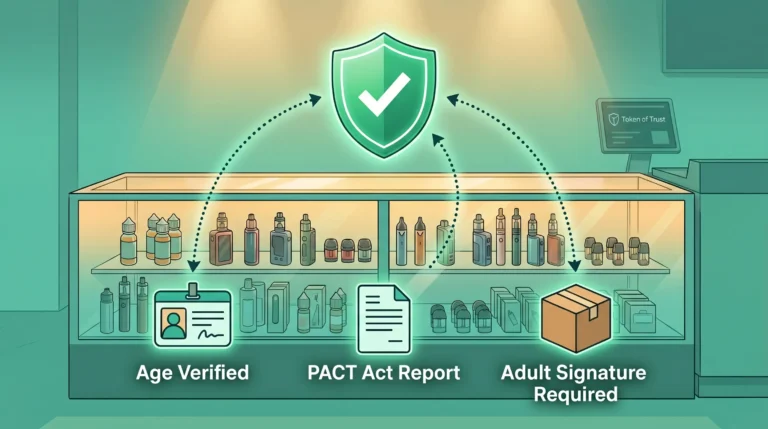
Brands that are not already operating with:
- Robust age and identity verification
- Clear audit trails
- Consistent buyer eligibility enforcement
will struggle to operationalize MRTP advantages—even if the science and law allow it.
What Operators Should Be Doing Now
This isn’t a call to bet your roadmap on FDA outcomes. It’s a call to prepare for asymmetry.
Smart operators are:
- Tracking MRTP applications and TPSAC agendas
- Modeling tax exposure by state under MRTP scenarios
- Auditing whether their compliance stack could withstand MRTP-level scrutiny
- Treating nicotine pouches as a distinct regulatory class—not “vape-adjacent”
MRTP tax unlocks won’t arrive with a long runway. When they hit, the winners will be the brands that planned for them before they were obvious.
Because in regulated nicotine, the advantage rarely goes to the first approved product.
It goes to the operator who’s ready when the rules quietly change.
Don’t wait for regulators to set the rules. Token of Trust helps high-risk nicotine brands stay compliant with age and identity verification, so you can confidently pursue opportunities like MRTP tax advantages. Learn how we can protect your margins today.
→ Talk to an expert today