
California AB 1263 Compliance (2026): Firearm Accessories
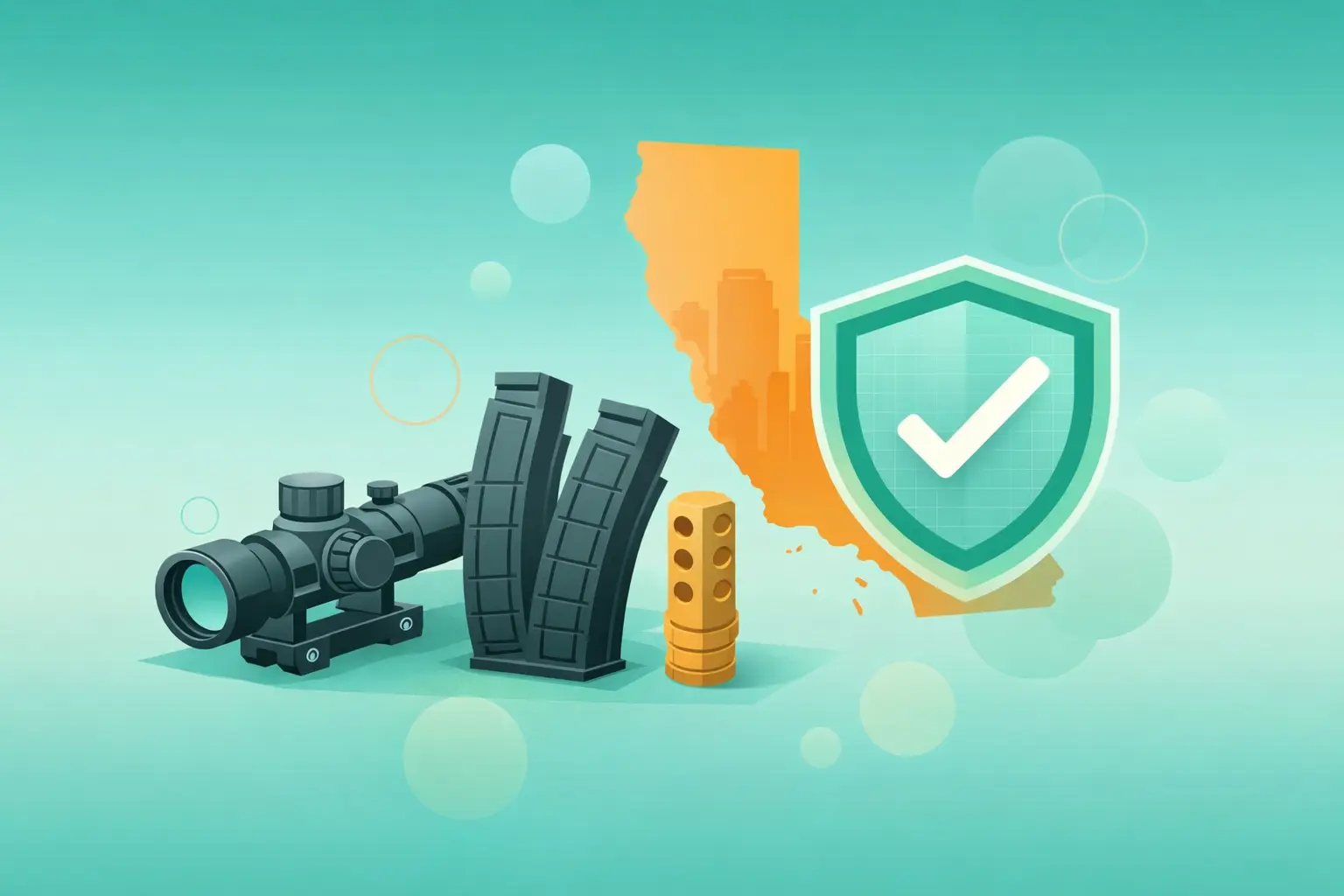
As of January 1, 2026, California AB 1263 is in effect and establishes new compliance requirements for ecommerce businesses selling firearm accessories, components, tools, or kits into California.
For any order shipping to a California address, merchants must verify the buyer’s age and identity, present a state-mandated compliance notice at checkout, and apply specific shipping and delivery controls before completing the sale.
While the law applies only to California-bound orders, its scope is broad. AB 1263 extends beyond complete firearms to cover many commonly sold firearm parts and accessories, including items intended to assist with firearm assembly or manufacturing.
Every CA-bound transaction must include the following:
- Show the state-mandated notice during checkout
- Capture buyer acknowledgment
- Collect proof of age and identity (18+) through verified AV + IDV
- Apply shipping safeguards, including package labeling, address matching, and ID + signature verification at delivery
These rules apply only to California-bound orders, but any U.S.-based seller shipping to California must comply.
Let’s walk through what you need to implement.
What California AB 1263 Requires in 2026
Applies if you ship any of the following to a CA address:
- Firearm accessory
- Firearm component, tool, device, kit, or “parts set” clearly designed for manufacturing a firearm
BEFORE completing the sale (checkout):
- Display the state-mandated notice to the buyer
- Capture buyer acknowledgment of that notice
- Require proof of age and identity (18+), via government-issued ID or biometric verification (AV + IDV)
FOR DELIVERY into California:
- Ship only to an address that matches the ID provided
- Include a package label with the AB 1263 warning language
- Require adult signature AND ID verification at delivery
Retention & Audit:
- Maintain a digital audit trail of each CA transaction: ID checks, consent capture, shipping confirmation
- Recommended: Retain records for at least 5 years to support audits or enforcement inquiries.
Why Accessory + Component Merchants Are Impacted Now
Historically, many accessory sellers assumed California firearm laws applied only to firearms or ammunition.
AB 1263 changes that.
The statute and Senate analysis emphasize an expanded definition of “firearm accessory,” including:
“Any other device, tool, kit, part, or parts set that is clearly designed and intended for use in manufacturing a firearm.”
That definition does not stop at serialized components. It can include items such as:
- Grips
- Stocks and chassis systems
- Handguards
- Optic mounts and rails
- Lower parts kits
- Trigger components
- Jigs and machining tools used in firearm assembly
If a product is clearly designed to be installed on, or used to assemble or manufacture, a firearm, it likely falls within AB 1263’s scope.
For merchants shipping nationwide, the challenge is simple: trigger stricter controls for California orders—without disrupting the rest of your checkout flow.
Merchant Scenario: How This Plays Out in Practice
Example: An MK Machining customer in California adds a scope leveling kit and bedding block to their cart.
Old workflow: Customer checks out with standard age affirmation checkbox. Package ships with no additional ID matching.
2026 workflow under AB 1263:
- Buyer sees and acknowledges CA compliance notice
- Buyer uploads a government-issued ID proving age 18+
- Token of Trust verifies the identity + age in real-time
- The shipping address matches the verified ID
- The package is labeled with the AB 1263 warning language
- The carrier confirms ID and captures an adult signature at delivery
If any step fails, the sale isn’t completed.
How Token of Trust Helps Merchants Satisfy AB 1263
Token of Trust is built to verify age and identity for regulated goods, with dynamic enforcement based on buyer location and product type.
Here’s how we help merchants meet every operational requirement of AB 1263, without rebuilding checkout or managing state logic manually.
At Checkout (CA-triggered flow)
✔️ Region-Based Policy Decisioning
Merchants send buyer region + cart details to Token of Trust. We return whether verification is required, along with reason codes and policy version information.
→ Only California-bound orders trigger the compliance workflow.
✔️ Hosted Verification (AV + IDV)
Token of Trust runs a verification session that collects proof of age and identity (18+), using government-issued ID and/or biometric matching.
→ Meets AB 1263’s “proof of age and identity” requirement.
✔️ Notice + Acknowledgment Capture
We present the required California notice and store the buyer’s acknowledgment with a timestamp.
→ Ensures compliance with the pre-sale disclosure rule.
For Shipping & Delivery
✔️ Address Match Enforcement
Token of Trust compares the verified ID address to the shipping address and returns a compliance flag if they don’t match.
→ Supports AB 1263’s “must ship to verified address” rule.
✔️ Delivery Instructions Output
We return the exact label text and delivery requirements needed for fulfillment.
→ Satisfies package labeling and adult ID/signature requirement.
Recordkeeping & Audit
✔️ Audit Trail + Compliance Logs
Every session stores the policy version, verification results, consent capture, and fulfillment metadata in a secure log.
→ Helps merchants prove compliance in case of enforcement or dispute.
No Custom Code Required
Token of Trust integrates with Shopify, WooCommerce, and other ecommerce platforms.
→ You don’t need to rebuild your checkout or plug in state logic manually.
Other States to Watch
AB 1263 isn’t an isolated event.
A growing number of states have adopted “gun industry accountability” or “reasonable controls” frameworks that impose obligations on firearm industry members, including sellers and distributors. States with these laws include:
- California
- Colorado
- Connecticut
- Delaware
- Hawaii
- Illinois
- Maryland
- New Jersey
- New York
- Washington
These laws differ in scope and implementation, but they share a common direction: state-level controls related to sales processes, verification, and recordkeeping.
Additional signals:
- Virginia has a prefiled 2026 bill (SB27) proposing “reasonable-controls” standards for firearm industry members. While not enacted, it signals continued legislative activity in this area.
- New York already requires ammunition sellers to maintain transaction records that include purchaser age and residence, illustrating how compliance requirements are expanding beyond firearms themselves.
State-by-state rules are continuing to evolve. Centralized, policy-driven enforcement helps merchants adapt as requirements change across jurisdictions.
FAQ: AB 1263 Compliance for Firearm Accessory Sellers
Does AB 1263 apply to firearm accessories, or only to firearms?
AB 1263 applies to firearm accessories, components, tools, kits, and parts sets if they are clearly designed and intended for use in manufacturing a firearm. This includes items such as jigs, tools, and parts kits, not just complete firearms.
Do I need to verify every buyer under AB 1263?
No. AB 1263 applies only to covered transactions involving California purchasers or orders shipping to a California address. Many merchants implement a California-triggered compliance flow rather than verifying all buyers nationwide.
What proof of age and identity is required under AB 1263?
Merchants must verify that the purchaser is at least 18 years old using verified proof of age and identity, such as a government-issued photo ID. Self-attestation or a simple checkbox is not sufficient. Some platforms automate this using ID upload and facial matching.
What are the shipping and delivery requirements for AB 1263?
For shipped or delivered orders, California DOJ guidance requires specific delivery controls, including state-mandated package label language, shipping address matching the purchaser’s verified ID, and ID verification with adult signature at delivery.
What records should merchants keep to demonstrate AB 1263 compliance?
Merchants should retain age and identity verification results, purchaser acknowledgments, timestamps, shipping confirmations, and policy context showing how compliance decisions were applied. Maintaining an audit-ready record helps support enforcement inquiries or disputes.
Next Steps for AB 1263 Compliance
If you are still validating how AB 1263 applies to your products, checkout flow, and fulfillment process, a structured checklist can help ensure no required step is missed.
→ Download: AB 1263 Compliance Checklist for Ecommerce Merchants
For merchants ready to operationalize these requirements, implementation often involves aligning checkout verification, shipping controls, and audit records across systems that were not designed to work together. Token of Trust works with ecommerce teams to review their current setup and apply California-specific compliance requirements without changing how they sell in other states.
→ Talk to a specialist. Book a compliance walkthrough
Disclaimer: This content is provided for informational purposes only and does not constitute legal advice. Merchants should consult legal counsel regarding their specific compliance obligations.