

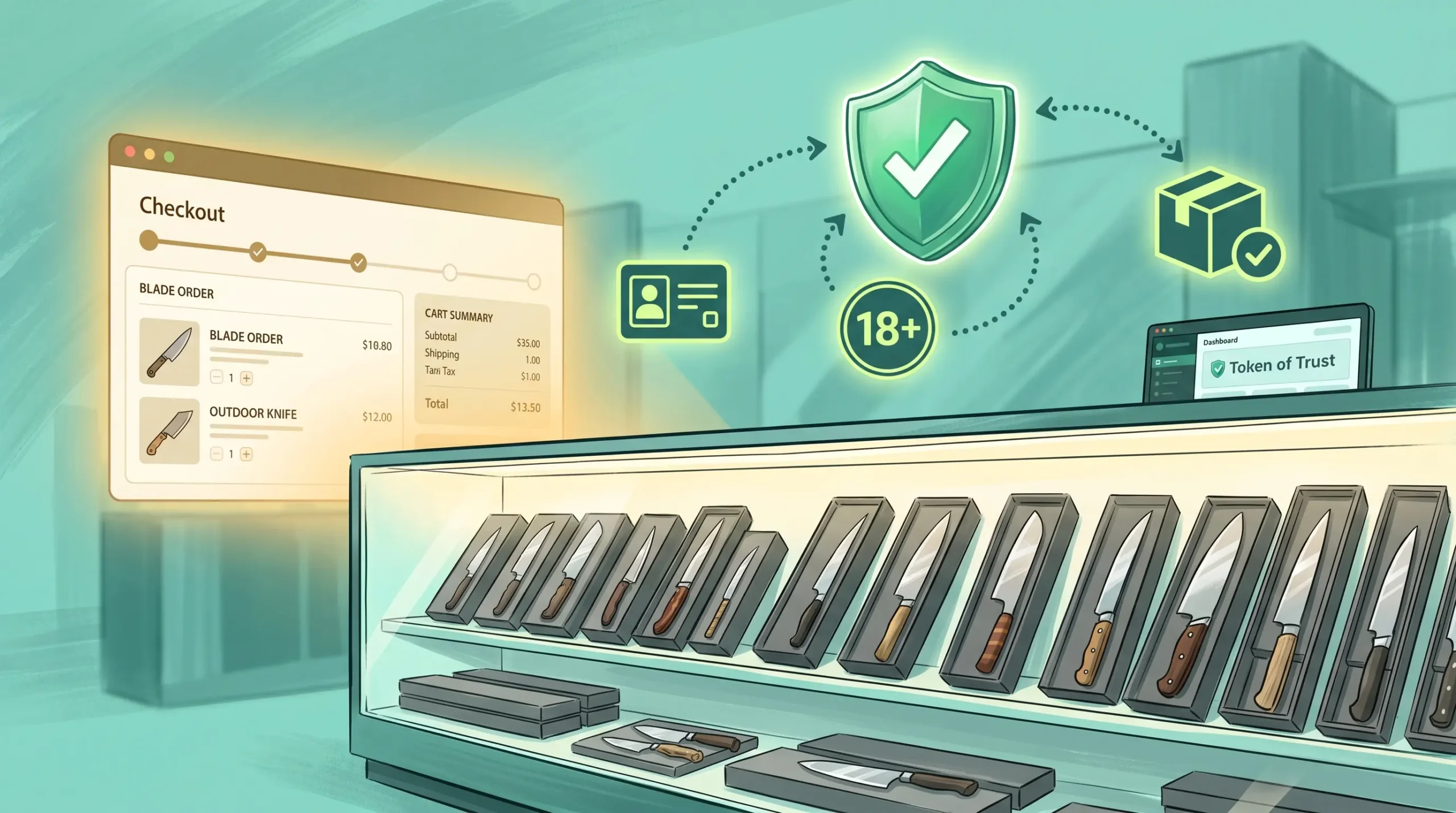
UK Knife Retailers: What the Crime and Policing Act 2026 Requires Now
The UK has moved from voluntary age checks to a legislated, 2-step verification standard for every online knife sale. The Crime and Policing Act 2026 received Royal Assent on 29 April 2026. Retailers must now verify a buyer’s identity at the point of purchase and again at delivery. If your current system relies on a self-declared date of birth or a checkbox, it does not meet the legal standard.
Why the Law Changed
The Offensive Weapons Act 2019 made it a crime to sell or deliver bladed items to anyone under 18. It also requires an effective age-check system. Enforcement began in April 2022.
About 50% of online retailers did not check a buyer’s age at the time of sale. National Trading Standards found this through test purchases carried out before enforcement began. That compliance gap drove the government to legislate a more specific standard.
The Home Office commissioned an independent end-to-end review of online knife sales. Published in February 2025, the review helped lead to “Ronan’s Law.”
It recommended mandatory, documented age checks at two points in every transaction. The Crime and Policing Act 2026 codifies exactly that.
Voluntary agreements and informal best-practice frameworks no longer set the standard. This is binding law with criminal penalties attached.
What the 2-Step Verification Requirement Now Requires
The Act mandates verification at two separate stages of every online sale.
Step 1: At the Point of Purchase
Before a customer can complete an order for any bladed article, they must submit:
- A copy of their physical passport or driving licence
- A photograph of themselves at the point of sale (a liveness check confirming the buyer matches the ID)
A self-declaration of age does not satisfy this requirement. Neither does a date-of-birth field at checkout.
The government has added rules that allow digital versions of these documents in the future. You can do this through secondary legislation. However, the default standard is physical document verification.
Step 2: At the Point of Delivery
The same person who placed the order must be present to receive the package. The courier must verify their identity and age at the door using an official identity document. We cannot complete the delivery without this confirmation.
Doorstep drops when no one is home are now illegal. You cannot deliver bladed items to lockers or automated collection points.
We cannot reliably verify age at those locations.
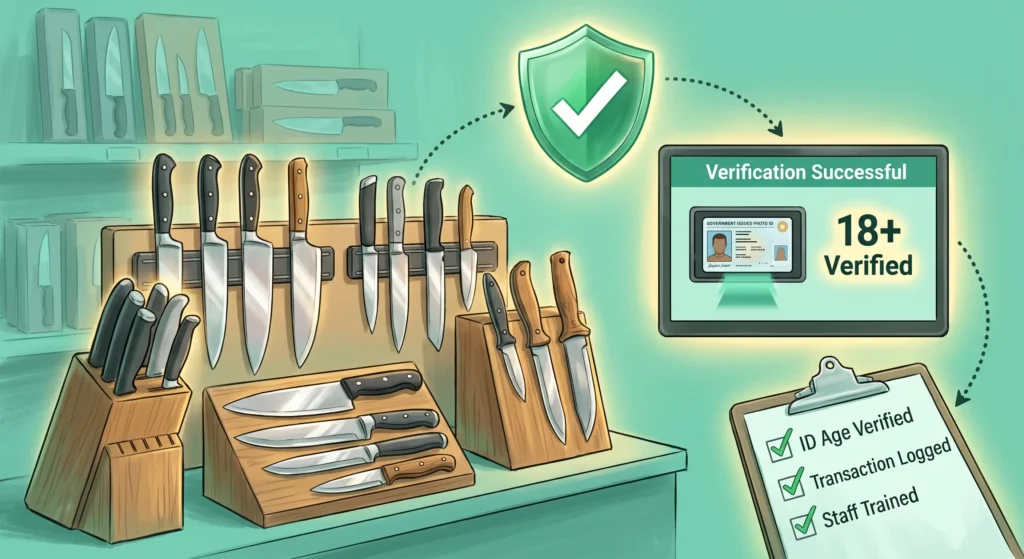
The Business Impact Most Retailers Are Underestimating
This law does not just affect your checkout flow. It touches fulfilment logistics, customer experience, and criminal liability at the same time.
Operational complexity at delivery. If you use a third-party courier, confirm your logistics partner has an ID check process at the door. Not all carriers offer this. Retailers relying on standard consumer parcel services with no delivery confirmation protocol need to revisit those contracts now.
Conversion and customer experience. Adding a verified ID step at purchase introduces friction.
Customers accustomed to a simple checkout may abandon their cart. Retailers who implement this poorly, with clunky upload flows or excessive data requests, will lose revenue. The answer is verification technology that is fast, mobile-friendly, and confirms identity without creating unnecessary barriers.
Criminal liability, not just fines. The Crime and Policing Act 2026 raises the maximum penalty for selling a bladed article to someone under 18.
It is now up to 2 years in prison if convicted on indictment. The due diligence defence, your protection as a retailer, depends entirely on demonstrating that your verification system was functional, documented, and consistently applied. A bypassed or broken checkout flow removes that defence.
Bulk sale reporting. The Act also adds a duty to report sales of six or more bladed articles in one transaction to the police. This targets grey market re-selling and adds a data handling requirement on top of the identity verification obligation.
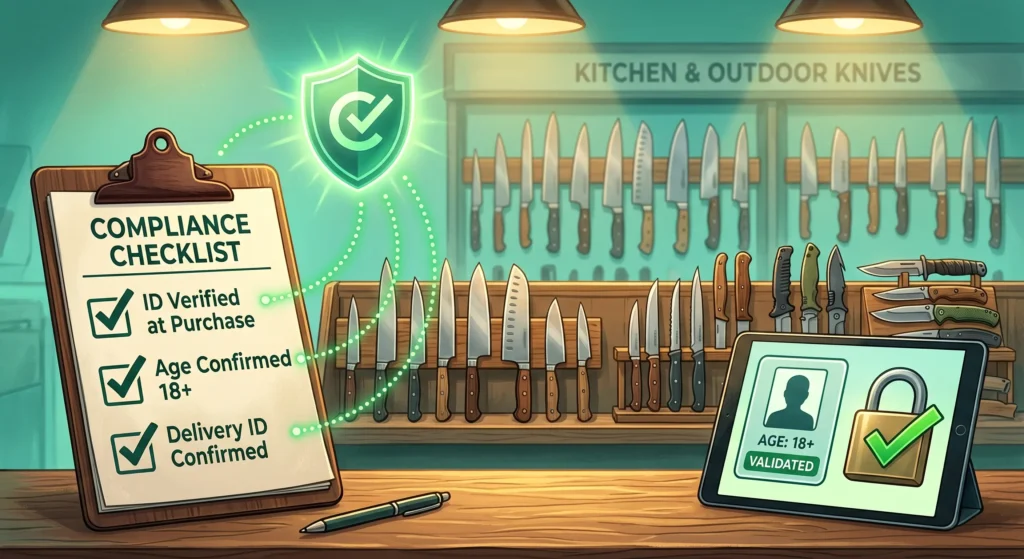
What “Due Diligence” Actually Requires
The Offensive Weapons Act 2019 created a legal defence for retailers. If they take reasonable precautions and exercise due diligence, they reduce their criminal liability. The Crime and Policing Act 2026 raises the floor on what that standard means in practice.
Courts and enforcement agencies will assess:
- Whether your system used validated documentation, not self-reported data
- Whether the liveness check (buyer photograph) was collected at point of sale
- Whether verification records were retained and auditable
- Whether delivery partners were contractually obligated to conduct step-2 identity checks
- Whether you tested your system regularly, including confirming under-18s cannot pass
Self-declaration checkboxes, date-of-birth selectors, and disclaimer pop-ups have never met the due diligence standard. Under the Act, they are explicitly non-compliant.
What This Signals Beyond Compliance
The required two-step process for knife retailers shows a wider change in UK rules for online age-restricted sales. Identity-linked verification at both purchase and delivery is now the legal baseline, not a premium feature.
Major retailers, including Amazon, Argos, John Lewis, and Tesco, had already signed the Home Office voluntary retailer agreement. They also committed to strong age checks as standard practice. Independent online retailers without that infrastructure now face the same legal duty.
They also have less time to set it up.
The government is also consulting on a broader licensing scheme for knife sellers. While that consultation ended in February 2026, the outcomes are still pending. It shows ongoing regulatory pressure on this category. Retailers who have built audit-ready verification now will be better positioned for whatever comes next.
The core question for most knife retailers is not whether to verify. The law requires it. The key question is whether the system is fast enough to protect conversions.
It also needs clear documentation so it can withstand scrutiny.
Finally, it must integrate tightly with fulfilment to handle step-2 delivery needs.
How Token of Trust Supports Online Knife Retailers
Token of Trust’s verification tools help regulated retailers meet age and identity verification rules.
They do this without adding friction that can cost sales.
Government ID Verification checks a copy of a passport or driving licence at purchase.
It does this automatically and in real time. We designed this to help meet the Step-1 document requirement under the Act.
Biometric Face Verification adds a selfie-to-ID match. It confirms the person submitting the document is the person placing the order. This supports the liveness check component the Act requires at point of sale.
Age Verification provides a fast eligibility check at checkout.
It creates documented, audit-ready records.
These records support a due diligence argument if challenged.
All three tools work with Shopify and WooCommerce. They help retailers show that they structured, applied consistently, and documented their verification process.
Read our blog about Age Verification: Understanding the Role of Identity to learn more.
The law is already in effect. Book a demo to see how Token of Trust supports age and identity verification for online knife retailers.
Source link: UK Home Office: Stricter age-verification checks for all knife retailers
FAQs
What does the Crime and Policing Act 2026 require for online knife sales? The Act requires a 2-step verification process for every online sale of a bladed article.
Step 1 happens at checkout. The buyer must submit a copy of their passport or driving licence. They must also provide a photo that confirms they are the holder. Step 2 takes place at delivery: the courier must verify that the person receiving the package is the same buyer who placed the order.
Is my current age verification system enough for UK knife sales? If your system uses a self-declared date of birth, a checkbox, or an unverified age gate, it fails the standard. Under the Crime and Policing Act 2026, it may also fall short. It may already fail the due diligence defence under the Offensive Weapons Act 2019.
A system must check physical photo ID, take a buyer photo at purchase, and keep auditable records. This is the required baseline.
What are the penalties for selling a knife to someone under 18 in the UK? The Crime and Policing Act 2026 raised the maximum penalty for selling a bladed article to someone under 18. The maximum sentence is now 2 years in prison on indictment.
The retailer reduces criminal liability only if they show they took reasonable precautions and exercised due diligence. This requires a documented and working verification system.
Do delivery companies also have obligations under the knife verification rules? Yes.
Couriers must confirm that the person receiving a bladed item is the same person who bought it. They must use an official ID. Retailers should confirm their logistics partners have a compliant delivery process in place. You cannot leave packages at doorsteps or deliver them to lockers.