
Does Your Checkout Verify at the Transaction Level? For Online Firearms Sellers, It Has To
NY ammo law, federal age minimums, and ATF inspections all require per-transaction verification. Here's what that means for your checkout workflow.
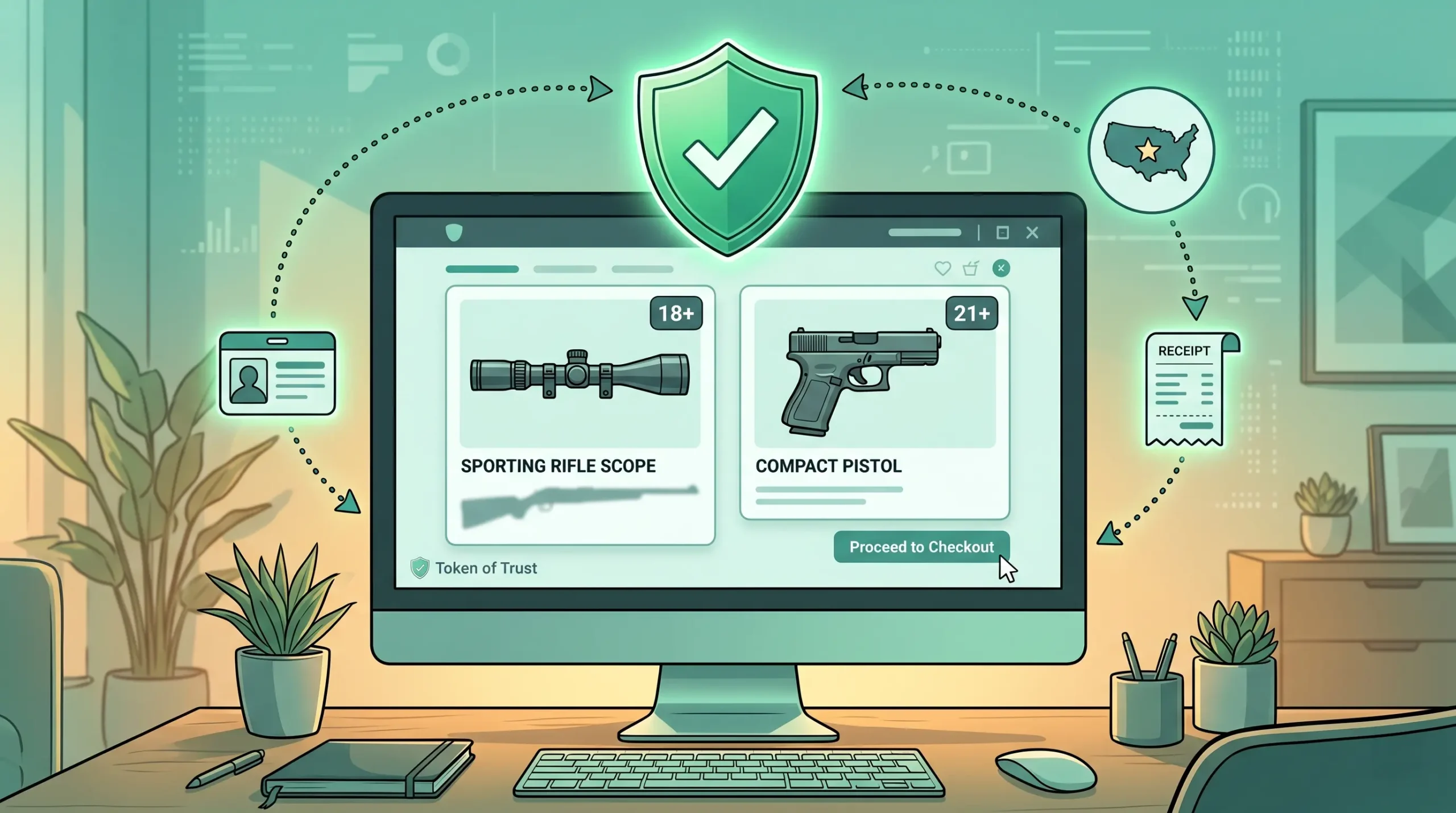
Two separate federal legal frameworks and one New York state law now require age and identity verification at the point of each transaction. Not at account creation. Not at first login. Every order. If your current system captures verification once and carries it forward, your records may not hold up under review.
This guide breaks down what each framework requires, where the common gap is, and what a compliant transaction-level workflow looks like in practice.
Why Account-Level Verification Is No Longer Enough
Most online sellers built their compliance workflows around account creation. A customer verifies their age, confirms their address, and clears a background check. The system flags them as verified. Future orders flow through without repeating the check.
That approach made sense when legal requirements were less specific. It does not match what regulators require today.
The gap is not in the intent. It is in the architecture.
Account-level verification asks: is this person who they say they are? Transaction-level verification asks: is this specific sale, on this date, for this product, to this address, documented correctly? Those are not the same question.
Learn more about how age verification for online retailers works at the transaction level.
What Three Legal Frameworks Now Require
1. New York Penal Law § 400.03: Per-Transaction Buyer Records for Ammo
New York's ammunition law does not create a checkout verification workflow for online sellers. It does something more restrictive: it prohibits direct online delivery of ammunition to New York consumers entirely.
Under § 400.03(7), no commercial transfer of ammunition may take place unless a licensed dealer in firearms or registered seller of ammunition acts as an intermediary, and that transfer must occur in person. An online seller shipping ammunition to a New York address must route the shipment to a licensed New York FFL or registered seller of ammunition. That dealer completes the in-person transfer, runs the required statewide database check, verifies the buyer's identity against a valid photo ID, and captures the transaction record.
The per-transaction record requirement under § 400.03(2) falls on the dealer completing the in-person transfer, not on the online seller's checkout. That record must include the date, the buyer's name, age, occupation, and residence, as well as the amount, calibre, manufacturer's name, and serial number of the ammunition transferred.
The compliance obligation for an online seller shipping to New York is to route all ammo orders through a licensed NY transfer point and not ship directly to consumers. A checkout-level age gate does not satisfy this law. The in-person transfer intermediary is the requirement.
2. 18 U.S.C. § 922(b)(1): Product-Type Age Logic at Every Sale
Federal law sets two different age thresholds: 18 for long guns, 21 for handguns. A checkout that applies a single age gate regardless of what is in the cart will pass a 19-year-old buyer on a handgun order. That is a federal violation at the point of transfer.
The correct threshold must be determined per order, based on what is being purchased. Product-level age logic needs to run at checkout every time.
States can require higher minimums than the federal floor, but they cannot go below it. For sellers shipping across multiple states, the federal threshold is the baseline. State requirements layer on top of it. A single account-level age check cannot handle that.
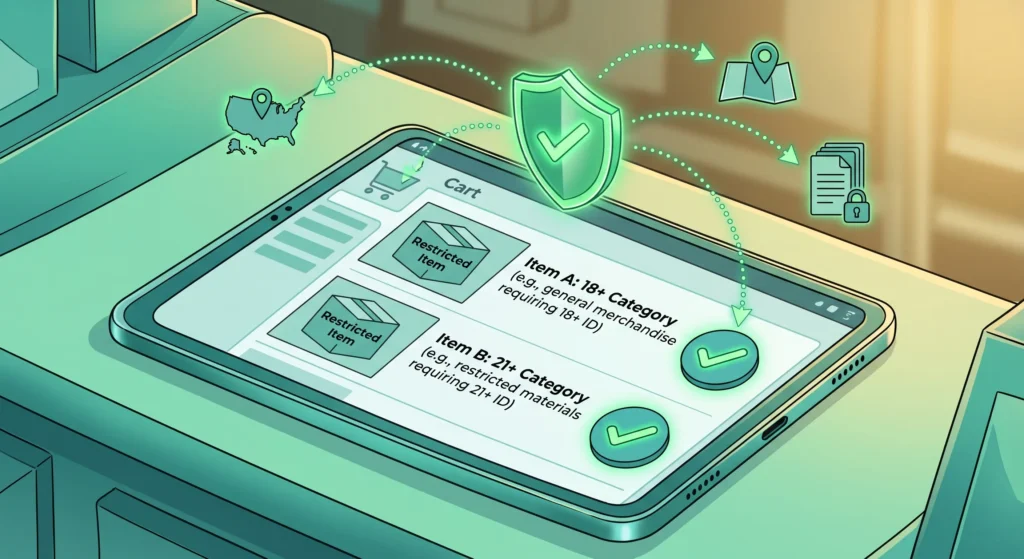
3. ATF Inspection Standards: Individual Transaction Records Are What Inspectors Check
ATF's compliance inspection framework evaluates traceability at the transaction level. When an inspector reviews bound book entries, NICS logs, and ATF Form 4473 records, they are looking at individual sales. They are not reviewing system-level settings or onboarding documentation.
The three areas most commonly flagged in inspections map directly to per-transaction documentation under 27 CFR Part 478:
Bound book accuracy: Every acquisition and disposition entry must be complete, correctly timed, and tied to a specific transaction.
NICS log completeness: Each check must be documented against the individual transfer record. The date NICS was contacted must appear on the Form 4473 for that specific transfer. A check run at account setup does not create a record tied to a specific sale.
FFL license validation: Before transferring a firearm to another licensee, the receiving FFL must furnish a certified copy of their license under 27 CFR 478.94. ATF also recommends using FFL eZ Check as a best practice to confirm license validity before each dealer-to-dealer transfer. This is a recommended verification step, not a separately codified mandate, but it is one ATF inspectors expect to see reflected in your process.
If the record for a specific sale does not have the required documentation, the account-level record does not save it.
What a Compliant Transaction-Level Workflow Captures
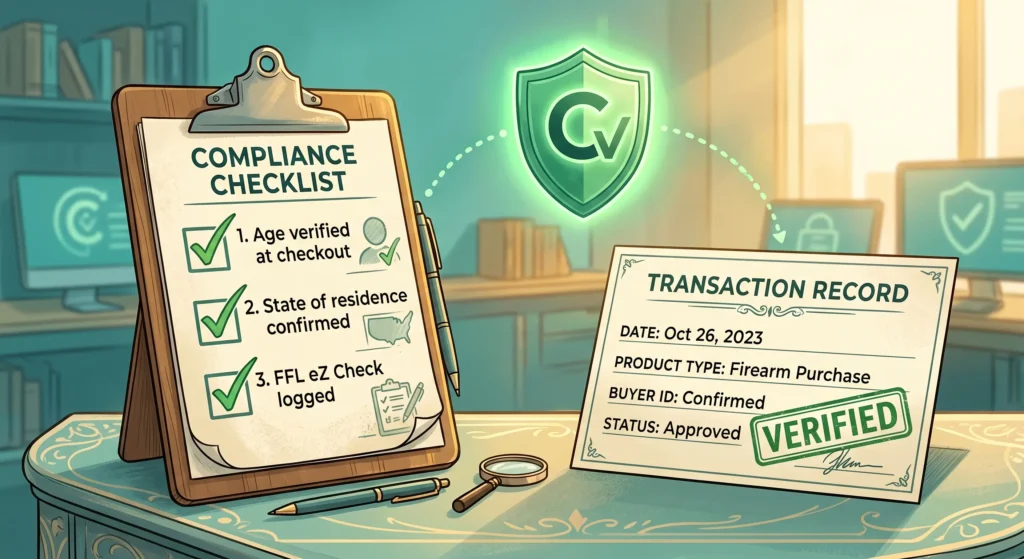
A compliant workflow documents the following at the point of each order:
- Age verification against the correct threshold for the specific product being purchased
- State of residence confirmed at checkout, not assumed from the account record
- For dealer-to-dealer transfers, a certified copy of the receiving FFL on file under 27 CFR 478.94, with FFL eZ Check used as a recommended validation step
- NICS check documented and tied to the individual transfer, with the contact date recorded on Form 4473
- ATF-reportable events, including multiple handgun sales and denials, flagged and filed at the time of the transaction using ATF Form 3310.4
- For orders shipping to New York, routing to a licensed NY FFL or registered seller of ammunition for in-person transfer completion under § 400.03(7)
The operational test is simple. If a compliance question surfaces about a specific sale, the record for that sale should answer it on its own.
How Token of Trust Supports Transaction-Level Compliance
Token of Trust runs age and identity verification at the transaction level. It matches checks to the product type in the cart, the buyer's state of residence, and the applicable federal or state threshold.
For online firearms and ammunition sellers, that means:
- Age thresholds applied by product type on every order, not a single gate for all products
- State of residence confirmed per transaction against the current shipping address
- Government ID verification integrated at checkout, with records tied to individual sales
- Verification results exportable in audit-ready format to support ATF inspection preparation
Token of Trust provides identity and age verification built for high-stakes online retail. Run verification at the transaction level: by product type, by state, every time.
The goal is to close the gap between what your workflow captures and what a compliance review will look for.
Ready to close the compliance gap at checkout? Book a Demo
Frequently Asked Questions
Does New York's ammunition law require verification on every online sale, or just at account creation?
Neither, in the way most online sellers assume. Under NY Penal Law § 400.03, direct shipment of ammunition to New York consumers is prohibited. All covered transfers must be completed in person through a licensed New York dealer in firearms or registered seller of ammunition. The per-transaction record requirement, which includes the buyer's name, age, occupation, and residence along with the product details, falls on that in-person dealer, not on the online seller's checkout. The compliance obligation for an online seller is to route all New York ammo orders to a licensed NY transfer point, not ship directly to the buyer.
What age threshold applies to online handgun sales under federal law?
Under 18 U.S.C. § 922(b)(1), the minimum age for purchasing a handgun from a licensed dealer is 21. For long guns, the federal minimum is 18. States may set higher minimums but cannot go below these federal floors. Your checkout needs to apply the correct threshold based on the specific product in the order.
What do ATF inspectors look for when reviewing transaction records?
ATF inspectors evaluate individual transaction records, not account-level controls. They review bound book accuracy, including complete entries and correct timing. They also review NICS log documentation tied to specific transfers, including the date NICS was contacted as recorded on Form 4473. For dealer-to-dealer transfers, inspectors expect a certified copy of the receiving FFL on file per 27 CFR 478.94, and ATF recommends using FFL eZ Check as a validation best practice before each transfer. Gaps in any specific transaction record are findings, regardless of broader system documentation.
Is running a background check at account creation enough to satisfy ATF requirements?
No. ATF's inspection framework requires that each transfer be documented at the transaction level. A NICS check run during account setup does not create a record tied to a specific transfer. The date NICS was contacted must be recorded on the Form 4473 for each individual sale. Each transfer needs its own documentation to support an ATF trace or inspection review.