
Vape Compliance 2026: State Directory Updates
Vape compliance 2026 is becoming more complex as multiple states expand requirements affecting the manufacture, distribution, and sale of electronic nicotine delivery systems (ENDS) and related vaping products. Recent changes include updates to product directory programs, licensing structures, sourcing restrictions, and marketing controls.
For businesses operating in the vape sector, compliance now requires closer coordination between licensing, product eligibility, ecommerce controls, and marketing oversight.
Below is a summary of key developments and the operational steps businesses should review.
What changed for vape retailers and manufacturers in Pennsylvania?
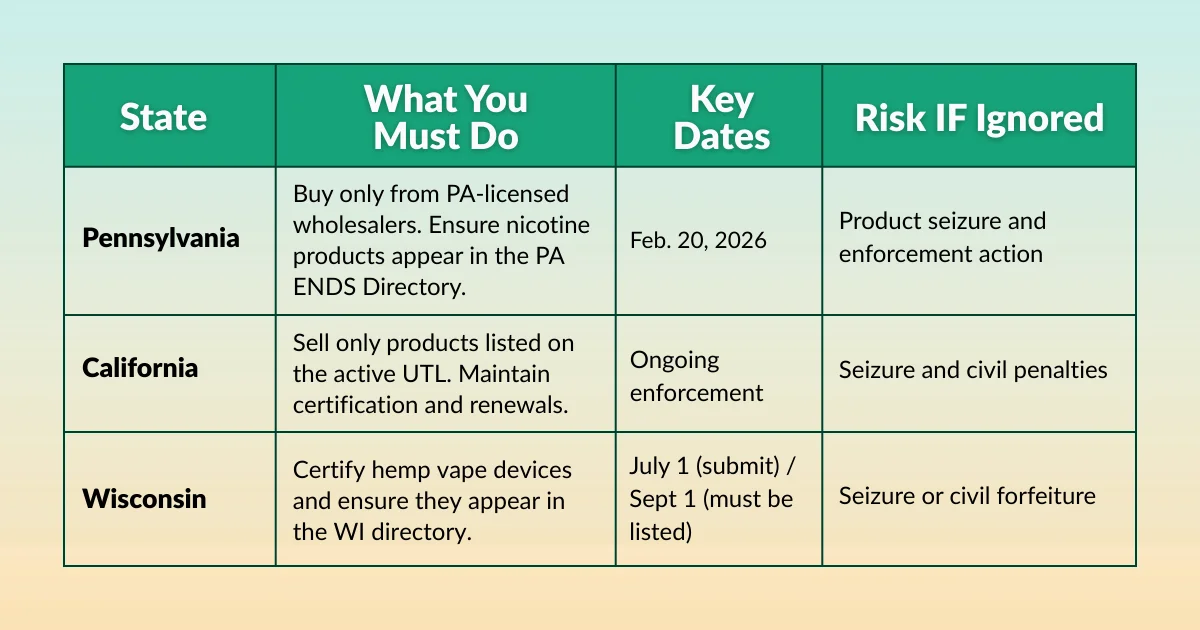
Pennsylvania’s Act 57 is now in effect and updated several requirements related to licensing, sourcing, and ENDS directory compliance.
What the law does
Act 57 modifies Pennsylvania’s tobacco product regulatory framework, including wholesale sourcing requirements and certification processes tied to the state ENDS directory administered with oversight from the Pennsylvania Office of Attorney General.
Who it applies to
- Vape retailers selling nicotine electronic cigarettes in Pennsylvania
- Manufacturers of nicotine-containing vaping products
- Wholesalers operating within the state
Key requirements
Retailers must purchase tobacco products only from Pennsylvania-licensed wholesalers.
Manufacturers must:
- Hold a Pennsylvania OTP manufacturer license
- Hold a Pennsylvania OTP wholesaler license if distributing products within the state
Each physical Pennsylvania location must maintain its own active license.
Manufacturers are required to submit certification to the Attorney General for eligible products. Only products appearing in the Pennsylvania ENDS directory may be sold at retail.
Products not listed in the directory may be subject to enforcement actions, including potential seizure.
Operational considerations
Businesses operating in Pennsylvania should:
- Review wholesale sourcing practices
- Confirm all SKUs appear in the state directory
- Verify licenses are active for each location
- Update internal compliance records and documentation
California’s Unflavored Tobacco List: What Determines Whether Your Product Can Be Sold
The California Department of Justice continues to enforce the Unflavored Tobacco List (UTL), which functions as the state directory of tobacco products certified as unflavored and eligible for sale. If a product is sold in California, it must appear on the active UTL and comply with current certification, renewal, and fee requirements. Products not listed may be subject to seizure, and retailers may face civil penalties. Enforcement remains in place during rulemaking transitions, including the February 19, 2026 15-day modifications.
Do hemp vaping devices need to be listed in Wisconsin?
Wisconsin is expanding certification requirements under its Electronic Vaping Device Directory, administered by the Wisconsin Department of Revenue, to include hemp-derived vaping devices.
Deadlines:
- July 1, 2026: Manufacturers must submit certification for hemp vaping devices.
- September 1, 2026: Unlisted hemp vaping devices may not be sold in Wisconsin and may be subject to seizure or civil forfeiture.
These changes affect manufacturers of hemp-derived vaping devices and retailers selling nicotine-free hemp vape products in Wisconsin. After September 1, 2026, any hemp vaping device not listed in the Wisconsin Electronic Vaping Device Directory should not be sold, as it may be subject to seizure or civil forfeiture.
What do these changes mean for vape ecommerce operators?
If you sell vape products online, compliance now spans:
- State directory listing requirements
- Licensing controls
- Wholesale sourcing validation
- Advertising restrictions
- Product eligibility tracking
For Shopify merchants, this directly affects checkout eligibility enforcement and SKU governance. If a product is not legally eligible for sale in a given state, your store needs mechanisms to prevent non-compliant transactions.
This is where age verification for Shopify vape stores and ID verification for regulated ecommerce become operational controls, not just marketing features.
How to stay compliant as a vape business in 2026
1. Audit product eligibility by state
Confirm that every SKU appears in required state directories where applicable.
Businesses should:
- Document directory listing identifiers
- Track renewal and certification deadlines
- Assign responsibility for monitoring regulatory updates
2. Validate licensing structure
Confirm:
- Manufacturer licenses remain active
- Wholesaler licenses are valid where required
- Location-specific licenses are properly issued
- Expiration timelines are documented
3. Implement defensible age and identity controls at checkout
For online sales of age-restricted products, operators should evaluate:
- Automated age verification
- ID verification workflows where appropriate
- State-based rule enforcement
- Retention of verification records for audit purposes
Age gates alone are generally not considered sufficient risk controls in regulated ecommerce environments.
4. Document advertising and marketing oversight
Maintain internal controls such as:
- Ad review logs
- Archived creative materials
- Substantiation for claims
- Reviews for youth-appeal risks
Language that regulators typically view as acceptable includes:
- “Designed to support state compliance requirements”
- “Supports age-restricted sales controls”
- “Helps businesses manage verification workflows”
Businesses should avoid absolute claims such as:
- “Fully compliant”
- “Guaranteed legal”
- “Regulator approved”
How Token of Trust Helps Vape Merchants
Token of Trust is designed to help regulated ecommerce businesses operationalize compliance without rebuilding their checkout flows.
For vape operators, that typically includes:
- Age verification tied directly to checkout
- ID verification workflows when required
- Audit-ready verification logs
- Platform integrations with Shopify and WooCommerce
- Configurable rule enforcement by jurisdiction
Our Proof-in-7 launch system helps merchants validate verification workflows quickly and generate documented evidence of what ran and what passed.
Token of Trust does not replace legal counsel. It is designed to support businesses in meeting age and identity verification obligations while maintaining operational efficiency.
FAQs
What happens if a vape product is not listed in a state directory?
If a product is missing from a required state directory, regulators may seize it and impose civil penalties on retailers. Do not sell unlisted products.
Can enforcement happen while rules are still being finalized?
Yes. California shows that regulators can continue enforcement under existing statutes and emergency regulations while permanent rules are still being finalized.
Can I sell the same vape product in every state if it’s legal federally?
Not necessarily. Many states operate their own directory programs, certification requirements, and product restrictions that determine whether a vape product can be sold there. A product eligible in one state may not qualify for sale in another.
If you sell vape or other age-restricted products online, compliance now needs to run inside your checkout, not in a spreadsheet. Token of Trust helps you enforce age and ID verification, apply state-based rules, and generate audit-ready proof tied to real orders. Start your free trial, run a live verification, and see it working in your store within days.