

PMTA Directory Laws: What Vape and Nicotine Businesses Need to Know Now
A product may be federally unauthorized or ineligible for a state directory. It may be under review, subject to a stay, listed, delisted, or in litigation.
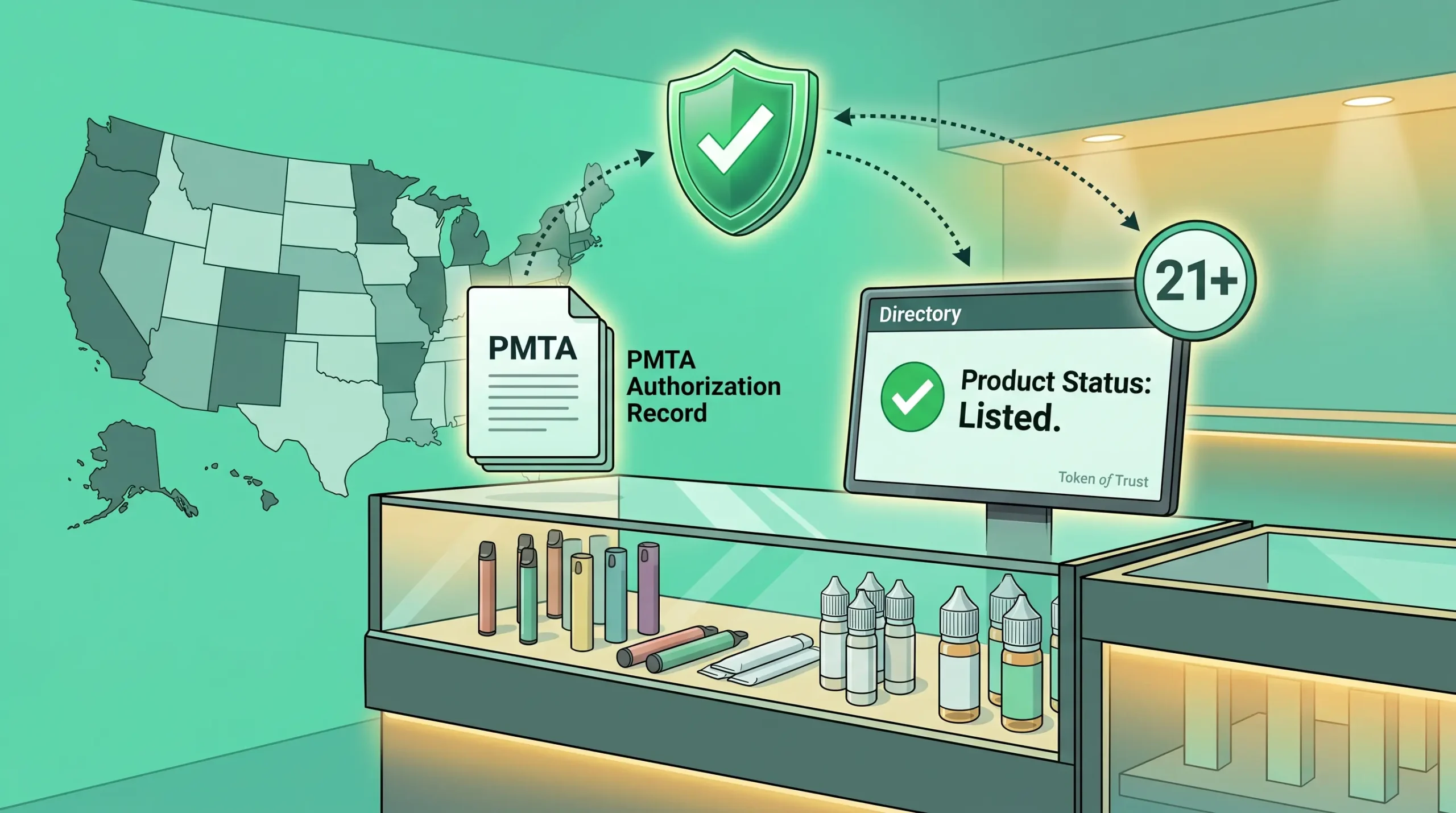
Even then, a retailer may still need a fast answer on stocking or selling it. That is the practical challenge that PMTA directory laws are creating for ENDS manufacturers, distributors, retailers, and marketplaces. The question is no longer just “does this product have a PMTA?” It is “does this product qualify under this state’s specific rules, and do we have the documentation to support that?”
This guide explains how PMTA directory laws work. It also covers the state landscape. It outlines key operational steps businesses should consider.
The Plain-English Takeaway for Busy Operators
Before going deeper, here is the short version:
- PMTA directory laws are state rules. They usually say a product needs certification or listing. If it is not, you may not sell it in that state.
- These rules can apply at the manufacturer, distributor, retailer, and marketplace level, not just at the product level.
- A product marked as “submitted,” “pending,” “listed,” or “authorized” can mean different things.
- It depends on the state and the product.
- Businesses need a product-status workflow, not just a column in a spreadsheet.
What Is a PMTA?
A Premarket Tobacco Product Application (PMTA) is a process.
It lets a manufacturer seek FDA authorization.
This authorization allows legal marketing of a new tobacco product in the United States.
The FDA states that companies generally must obtain written marketing authorization before they can legally market new tobacco products. That authorization comes through the PMTA pathway.
Key status terms and what they mean for operators:
- MGO (Marketing Grant Order): FDA has authorized the product. The company may legally market the product under the terms of the order.
- MDO (Marketing Denial Order): FDA has denied authorization. No one may legally market the product unless a court overturns the denial.
- Pending PMTA: A PMTA has been submitted but FDA has not yet issued a grant or denial. The product may be on the market in a legal gray zone depending on state rules.
- Stay: A court or agency has paused enforcement of an MDO while litigation or review proceeds. The product may remain on the market during the stay.
- Rescission or Vacatur: An MDO has been pulled back or set aside, often because of a procedural issue. The product is back in pending status.
- Under Review: FDA is actively reviewing the PMTA. The system contains the application, but it hasn’t issued an order.
Each of these statuses creates a different operational answer at the state level. States with directory or certification requirements may treat pending, stayed, and authorized products differently. Confirm the applicable rule with counsel for each state.
See our guide to vape flavor ban compliance, where FDA authorization status also affects product eligibility
How State PMTA Directory Laws Work
Most state PMTA directory laws follow a common model, though the details vary significantly.
The Common Framework
The typical directory eligibility test looks at three historical facts:
- Was the product on the market on or before August 8, 2016 (the FDA deeming rule effective date)?
- Was a PMTA submitted on or before September 9, 2020 (the applicable FDA deadline)?
- Is that PMTA still pending, or has someone stayed, rescinded, or vacated any denial?
If the product meets all three criteria, it may qualify for directory listing in states that follow this model. Products that did not exist before 2016 may not qualify under standard directory frameworks.
This may also apply if they submitted their PMTAs after 2020.
Why This Creates Operational Friction
The practical challenges for businesses operating across directory states include:
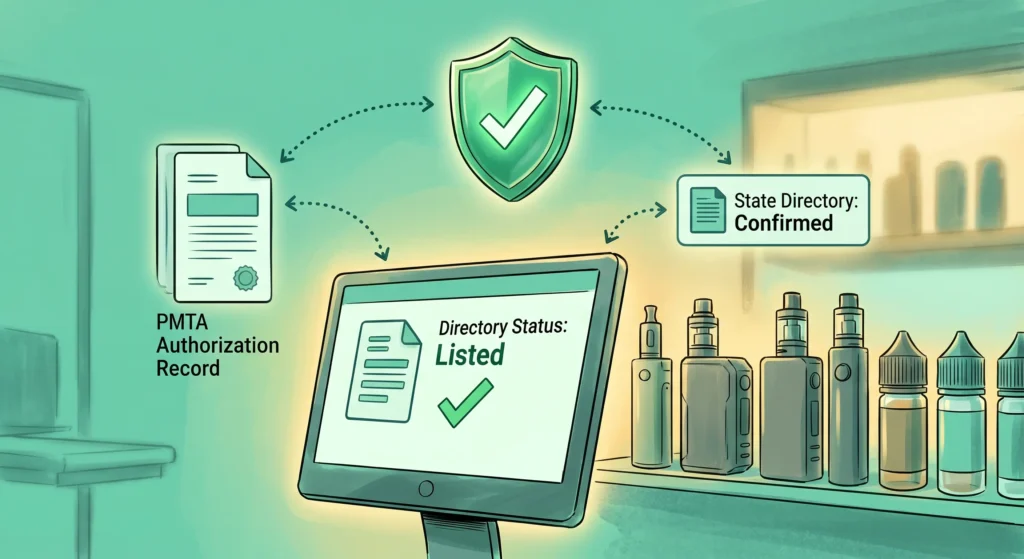
- Retailers may need to verify directory status before stocking a product
- Distributors may need to screen incoming inventory against eligibility rules in each destination state
- Marketplaces may need to block seller listings for products that are not listed or certified in the relevant state
- All parties may need documentation to demonstrate compliance in the event of an audit or enforcement action
Product status is not a one-time check. Someone may delist a product tomorrow that they list today.
This can happen if a court lifts a stay. It can also happen if someone rescinds an MGO. It may also happen if a state updates its directory.
State Examples: How Different Directory Models Work
The source materials list over 17 states with PMTA directory or certification-style frameworks.
These states include California, Louisiana, Illinois, Kentucky, Iowa, Florida, Oklahoma, Arkansas, Utah, and Mississippi.
They also include Virginia, Wisconsin, Tennessee, Alabama, South Carolina, North Carolina, and Pennsylvania. Some of those frameworks also apply to alternative nicotine or oral nicotine products, including California, Louisiana, Alabama, and North Carolina.
Five examples illustrate the range of approaches:
Alabama HB 8
Alabama’s framework is among the broadest. It covers tobacco-derived nicotine products, synthetic nicotine products, and nicotine analogs. Products that do not qualify under its criteria may be effectively ineligible for sale in the state.
The enforcement posture of Alabama HB 8 has been subject to a temporary restraining order. We must confirm what the law currently covers. We must also confirm how they enforce it. We need this information before making any compliance decision under Alabama’s framework.
Tennessee SB 763
Tennessee takes a multi-pathway approach. A product may qualify for sale through one of four routes:
- An FDA Marketing Grant Order
- A qualifying PMTA under the standard framework
- Limited brand or packaging changes tied to a qualifying product
- Consumable material processed or blended in the United States at an FDA-registered facility.
- It does not come from a foreign-adversary country.
The fourth pathway stands out because it links directory eligibility to domestic processing and origin. It connects Tennessee’s PMTA framework to supply chain compliance.
Pennsylvania HB 1425
Pennsylvania’s framework took effect March 1, 2026 per source materials. It includes a broad “brand family” concept that can cover related non-nicotine products. You must link these products to a qualifying nicotine brand. Product and compliance teams should review whether brand-family definitions extend their obligations beyond core ENDS products.
Louisiana Act 414 and the V.A.P.E. Directory
Louisiana’s V.A.P.E. Directory applies to vapor products and alternative nicotine products. This gives it a broader scope than frameworks limited to tobacco-derived ENDS. The source materials indicate that Louisiana has applied some enforcement discretion for certain analog products with lab testing documentation.
Virginia SB 550
Virginia’s directory is tied to MGO status or timely pending and unresolved PMTAs. The preliminary injunction that paused enforcement is no longer in effect. Enforcement reportedly began in March 2026, according to source materials. Businesses selling into Virginia should treat the directory requirement as active.
Enforcement Is Not Only Federal Anymore
Federal enforcement of PMTA obligations has historically been the primary focus for ENDS businesses. That is changing.
The FDA states that unauthorized new tobacco products may face administrative, civil, and criminal enforcement. The FDA also intends to ensure compliance by manufacturers, distributors, and retailers.
States are building their own enforcement structures on top of federal requirements. State directories create independent obligations that can affect market access even for products that are navigating federal PMTA review. A product with an active federal PMTA may still be ineligible in a state directory. It may not meet that state’s specific criteria.
The enforcement risk now has two layers: federal authorization status and state directory status. These are separate compliance questions that you must track on their own.
Operational Checklist for PMTA Directory Compliance
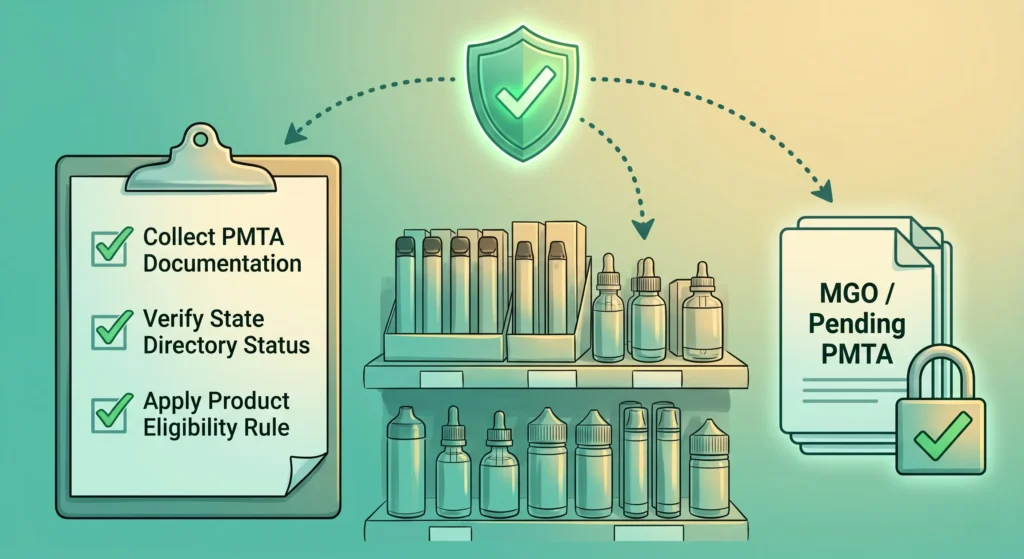
Use this as a working framework. Confirm jurisdiction-specific requirements with legal counsel.
Product Data Fields to Create
- FDA authorization status: MGO, pending PMTA, MDO, stayed MDO, rescinded MDO, vacated MDO, not submitted
- PMTA submission date: confirm whether it falls before or after September 9, 2020
- Market presence date: confirm whether the product was on market on or before August 8, 2016
- State directory status: listed, not listed, certification submitted, certification pending, ineligible
- Brand family associations: identify any related products that may be captured by brand-family definitions
- Product category: ENDS, e-liquid, oral nicotine, alternative nicotine, synthetic nicotine, analog
Documents to Collect and Store
- FDA MGO or acknowledgment of timely PMTA submission
- Stay orders, rescission notices, or court orders affecting MDO status
- State directory listing confirmation or certification documents
- Manufacturer attestations for distributor and retailer compliance files
- Facility registration records where processing-pathway eligibility applies (Tennessee)
Checkout and Listing Controls
- Build product-level eligibility fields that map each SKU to state directory status
- Block or flag sales in directory states where product status is unconfirmed
- Trigger manual review when a product’s PMTA or directory status changes
- Apply separate eligibility rules for alternative nicotine and oral nicotine products in states where those categories are covered
Audit Readiness
- Log which product status rule was applied at the time of each sale or listing decision
- Record the document version and date used to confirm eligibility
- Set a review cadence for product status fields so changes in authorization or directory status are reflected quickly
- Maintain retailer and distributor documentation files for potential audit requests
Questions to Ask Legal Counsel
Before applying any PMTA directory framework to a specific product or state, work through these with qualified counsel:
- Does this state’s directory law apply to this exact product category? Does it cover oral nicotine, synthetic nicotine, or analog products?
- Does a PMTA submitted after September 9, 2020 qualify under any pathway in this state?
- Does a current stay, rescission, or court vacatur affect the product’s directory eligibility?
- Who bears responsibility under this state’s law: the manufacturer, distributor, retailer, or all of the above?
- Does the brand-family concept in states like Pennsylvania extend obligations to non-nicotine products in a brand line?
- What documentation is sufficient to demonstrate directory eligibility in the event of an audit?
How Token of Trust Supports PMTA Directory Compliance Workflows
Token of Trust helps businesses collect product documents. It also helps manage seller compliance. It applies product eligibility rules in age-restricted commerce workflows.
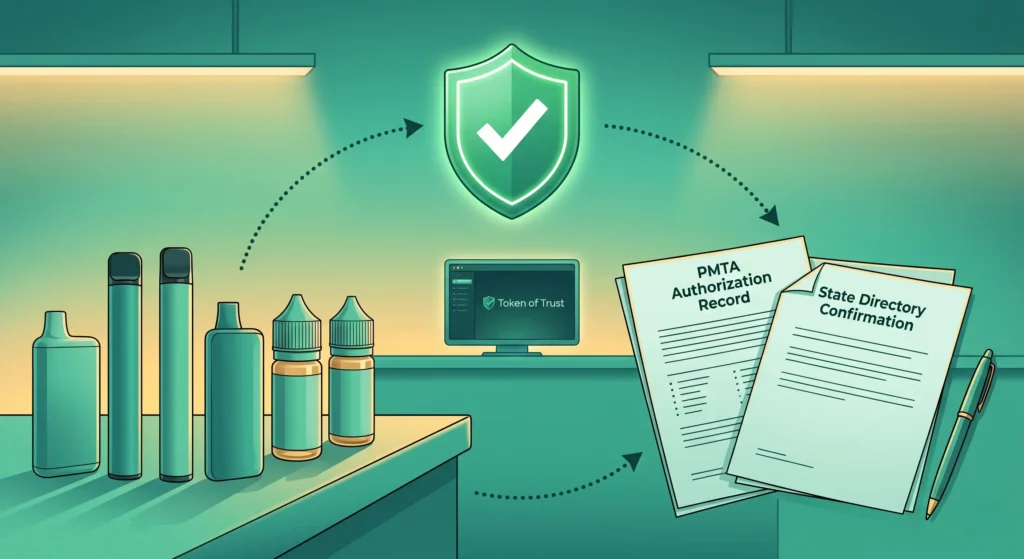
Merchant and Seller Onboarding: Collect PMTA documents, MGO records, stay orders, and state directory confirmations. Do this during onboarding before you approve a product for listing or sale. Reduces the risk of ineligible products reaching the shelf or the checkout page.
Product Eligibility Rules: Create product-level eligibility controls. Map each SKU to its current directory status in each applicable state. Apply those rules at checkout or at the listing stage for marketplace operators.
Status Change Triggers: When a product’s PMTA or directory status changes, eligibility rules should update accordingly. Token of Trust’s workflow tools support manual review queues. They also flag changes that require a new review before they sell a product.
Audit-Ready Logs: Every verification and eligibility decision is logged. Records show which product status rule users applied, which document version they kept on file, and what checkout or listing result they got.
Token of Trust helps translate regulatory status into operational decisions. It is not a substitute for legal counsel on PMTA submissions, directory filings, or product-specific authorization analysis.
Get Started
Ready to add product documentation workflows, state-level eligibility controls, and audit-ready logs to your vape operations?
Talk to one of our compliance experts
Frequently Asked Questions
Q: What is a PMTA directory law? A: A PMTA directory law is a state rule. It limits product sales to those approved by the FDA.
It may also allow products with a PMTA on file. States with these laws typically maintain a directory or registry of products that meet their criteria. That state may not allow the sale of products not listed in the directory. This depends on state law and the product category.
Q: Can companies sell a product in directory states while the PMTA remains pending?
A: It depends on the state. Many directory frameworks allow products with PMTAs submitted on time, before September 9, 2020.
The FDA may still review these PMTAs, or a court may stay their denials.
However, state rules vary in how they define qualifying PMTA status. Some states have specific filing or certification requirements beyond simply having an active PMTA. Confirm the applicable rule with legal counsel for each state.
Q: Do PMTA directory laws apply to oral nicotine pouches and alternative nicotine products?
A: In some states, yes. California, Louisiana, Alabama, and North Carolina have frameworks that extend to alternative nicotine products, which can include oral nicotine pouches. The product category definitions vary by state. Businesses selling oral nicotine products should not assume PMTA directory analysis applies only to vapor products.
Q: Who is responsible for PMTA directory compliance: the manufacturer, distributor, or retailer?
A: It depends on the state. Some frameworks put most responsibility on manufacturers.
They must certify or list products before distributors or retailers can sell them. Others create obligations at multiple levels of the supply chain. All parties in the distribution chain should understand their obligations in each directory state where they operate.